Why Must a Prosthetic Leg Socket Be Comfortable and Well-Fitted? Its Effect on Activity and Gait
14 Agustus 2026·Ibrahim Medical6 menit baca
Why Must a Prosthetic Leg Socket Be Comfortable and Well-Fitted? Its Effect on Activity and Gait
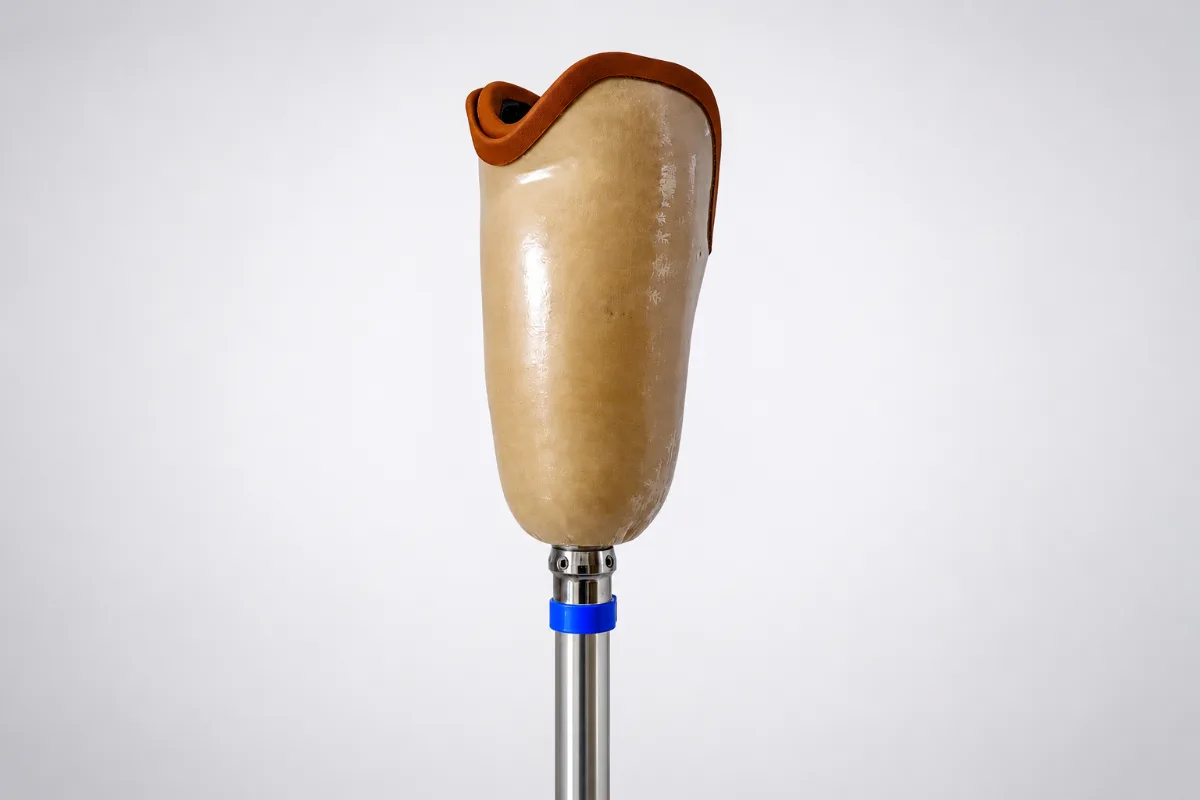
For prosthetic leg users, the socket is one of the parts that most determines the comfort and function of the prosthesis. The socket is the component that connects the residual limb to the rest of the prosthetic leg. Because it is in direct contact with the body, the precision of its design and fitting can affect comfort, stability, and the user's ability to carry out daily activities.
A socket that looks good in shape doesn't necessarily provide optimal comfort. Every user has a different residual limb condition, soft tissue shape, volume, activity level, and needs. Therefore, the process of making and fitting a socket needs to be tailored individually.
- What Happens If the Socket Doesn't Fit Properly?
A socket that is too loose can cause the residual limb to move within the socket, a condition often referred to as pistoning. This can reduce control over the prosthesis and make the user feel less stable while walking.
Conversely, a socket that is too tight or places excessive pressure on a certain area can cause pain, redness, blisters, or even skin damage. Pressure and shear force on the skin are among the factors that can cause problems in the area in contact with the socket.
Research on prosthesis user experience also shows that socket fit issues are one of the important factors affecting the rehabilitation process. Both users and rehabilitation professionals consider socket fit to have a major influence on the ability to carry out activities and the process of adapting to the prosthesis.
- A Comfortable Socket Doesn't Just Mean "Not Painful"
Socket comfort isn't determined only by the presence or absence of pain. Users also need to feel stability, good control over the prosthesis, and appropriate pressure distribution while standing or walking.
In socket evaluation, user comfort is one of the most commonly used parameters. However, comfort can change over time due to changes in residual limb volume, activity, tissue condition, and other factors.
That's why a socket that feels comfortable at the start of wear won't necessarily provide the same condition after being used for several hours or after the user performs certain activities.
- Why Does the Shape of the Residual Limb Matter?
After amputation, the condition of the residual limb can change. Changes in tissue volume and the shape of the residual limb can affect the relationship between the body and the socket.
Even when a socket was originally well made, changes in residual limb volume can cause the socket to feel looser or press more on certain areas. These changes can increase the risk of discomfort and skin problems.
This is what makes the prosthesis fitting process not stop once the socket is finished. Evaluation and adjustment after use are also an important part of achieving an optimal fit.
- The Socket's Influence on Gait
The socket acts as the main connector between the user's body and prosthetic components such as the knee joint, pylon, and foot. When the connection between the residual limb and the socket is unstable, users can experience difficulty controlling the prosthesis.
Besides socket fit, alignment — the alignment of prosthetic components — also plays a role in determining how the prosthesis performs when used for walking. Alignment evaluation generally involves assessment by a prosthetist and can be combined with objective methods such as an alignment jig or gait analysis.
Thus, comfort and walking ability aren't determined solely by the type of foot or knee joint used. Socket, alignment, prosthetic components, and user ability need to be considered as a single unit.
- What About Sweat and Heat Inside the Socket?
Sweat and rising temperature inside the socket can also be a source of discomfort. A humid environment can increase the risk of skin problems, especially when there is pressure and friction between the skin and the socket or liner.
A rapid review conducted in 2026 found that various approaches have been developed to help manage temperature and moisture in sockets and liners, including the use of certain materials, socket structure modifications, suspension systems, sealing, and ventilation or perforation.
However, the right solution still needs to be tailored to each user's condition and needs.
- When Should a Socket Be Checked or Adjusted?
Users should not ignore changes that occur while using a prosthetic leg. Some signs to watch for include:
- The socket starting to feel too tight or too loose.
- Pain appearing in a certain area.
- Skin turning red after use.
- Blisters or wounds appearing.
- The prosthesis feeling unstable.
- Excessive movement felt inside the socket.
- A change in gait or gait becoming more difficult.
- The prosthetic leg feeling comfortable at first but becoming increasingly uncomfortable after a few hours.
If persistent or worsening complaints appear, use of the prosthesis should be evaluated by a professional. Skin problems that go untreated can develop into more serious skin damage.
- Every User Needs a Different Socket
There is no single socket design that is automatically the best fit for everyone. The type of amputation, residual limb shape, tissue condition, activity level, suspension system, prosthetic components, and user preference can all influence the choice of design.
Recent research on transfemoral sockets also shows that certain designs can provide benefits for some users, but their success and comfort can still vary between individuals.
That's why prosthetic leg fabrication should be carried out through an evaluation and fitting process that considers each patient's needs, not just based on the size or shape of the residual limb.
- Conclusion
The socket is one of the most important parts of the prosthetic leg system because it is the main point of connection between the user's body and the prosthesis. Socket fit can affect comfort, stability, prosthesis control, skin condition, and the adaptation and rehabilitation process.
If a prosthetic leg feels uncomfortable, too loose, presses too hard, or causes skin problems, this condition should not be left unaddressed. Evaluation and adjustment by a prosthetist can help determine whether socket modification, alignment adjustment, or a change in other components is needed.
"A good prosthetic leg is not only about the components used, but also about how the entire system is tailored to the needs of its user."
References
1. Shahapurkar GS, Kashelkar R, Bapat GM. User-informed evidence on below-knee prosthetic socket failures, fit, and discomfort: insights from a cross-sectional study in India. Disability and Rehabilitation, 2026. [PubMed – User-informed evidence on below-knee prosthetic socket failures]
2. Gates DH, et al. Effect of Transfemoral Adjustable-Volume Sockets on Socket Comfort and Quality of Life: A Randomized Controlled Trial. Archives of Physical Medicine and Rehabilitation, 2026. [PubMed – Adjustable-Volume Sockets]
3. Stokosa JJ. Skin Care of the Residual Limb. MSD Manual Professional Edition, reviewed May 2026. [MSD Manual – Skin Care of the Residual Limb]
4. Turner S, McGregor AH. Perceived Effect of Socket Fit on Major Lower Limb Prosthetic Rehabilitation: A Clinician and Amputee Perspective. Prosthetics and Orthotics International, 2020. [PMC – Perceived Effect of Socket Fit]
5. Morgan SJ, Askew RL, Hafner BJ. Measurements of Best, Worst, and Average Socket Comfort Are More Reliable Than Current Socket Comfort in Established Lower Limb Prosthesis Users. Archives of Physical Medicine and Rehabilitation, 2022. [PubMed – Socket Comfort Measurements]
6. Temperature and moisture management and mitigation techniques in prosthetic sockets and liners: A rapid review. Prosthetics and Orthotics International, 2026. [PubMed – Temperature and Moisture Management in Prosthetic Sockets]